
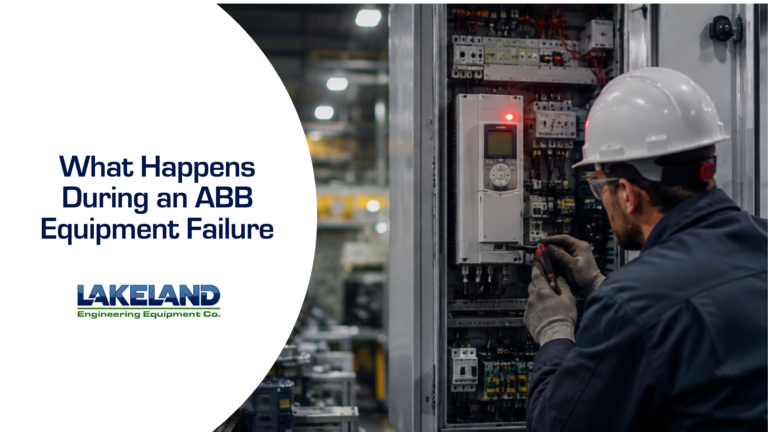
When an ABB drive trips out at 2 a.m. or a motor control center goes down mid-shift, the clock starts immediately.
Every hour a production line sits idle costs money, and the source of the replacement part determines how fast that line starts moving again. This is where the difference between a local ABB Inc distributor and a distant supplier becomes obvious. Proximity, stock, and technical knowledge decide whether a failure costs you an afternoon or an entire week.
What Actually Happens During an ABB Equipment Failure
Equipment failures rarely happen on a convenient schedule. A VFD burns out, a contactor fails, or a PLC module stops communicating, and maintenance teams are left diagnosing the problem under pressure. The diagnosis is only step one. Once the failed component is identified, someone has to locate the exact part, confirm compatibility with the existing system, and get it onsite fast enough to matter.
National distributors and online marketplaces can often identify the part. Getting it to a facility in Fargo, Omaha, or Kansas City by the next shift is a different problem entirely. Shipping delays, warehouse locations hundreds of miles away, and call centers unfamiliar with the specific application all add hours or days to a repair that should take minutes to source.
The Real Cost of Downtime in Manufacturing
Manufacturers rarely calculate the true cost of downtime until they are living through it. Lost production, missed shipping deadlines, idle labor, and potential contract penalties stack up fast. A single failed component worth a few hundred dollars can trigger losses in the tens of thousands once the full line stops.
An ABB distributor with local inventory and technical staff nearby changes this equation. Instead of waiting on a part shipped from another region, plants can pull from regional stock, get a same-day answer on compatibility, and often have a technician on the phone within minutes of the call.
Why Distance Determines Recovery Time
Distance affects three things during an equipment failure: response time, inventory access, and technical support quality. A distributor located in the same region understands local industries, common failure patterns, and the specific ABB product lines used across nearby plants. That familiarity speeds up diagnosis and part selection.
The table below compares what manufacturers typically experience with a local ABB Inc distributor versus a national call center or ordering directly from ABB.
| Factor | Local ABB Distributor | National Call Center / Online Order | Direct from ABB |
| Response time | Same day, often within hours | 1 to 3 business days | Varies by region and demand |
| Inventory access | Regional stock on hand | Centralized warehouse, longer transit | Manufacturing lead times apply |
| Technical support | Local engineers familiar with your systems | General support queue | Product-level support, less application context |
| Emergency parts sourcing | Direct relationships with regional plants | Standard shipping timelines | Limited emergency channels |
| Application knowledge | Familiar with regional industries and use cases | Generic product knowledge | Deep product knowledge, less field context |
| Relationship continuity | Same team, ongoing account history | Rotating representatives | Account managers, less hands-on support |
For a plant managing an active failure, this table translates directly into hours of downtime saved or lost.
What to Look For in an ABB Inc Distributor
Not every distributor carrying ABB products delivers the same level of support. Manufacturers evaluating a distributor for emergency readiness should look for a few specific things.
Authorized distributor status. Confirm the distributor is an authorized ABB channel partner. This ensures genuine parts, proper warranty coverage, and access to ABB’s full technical resources.
Regional inventory. Ask where the closest stocked warehouse is located and what percentage of common ABB parts are kept on hand locally rather than ordered on demand.
Engineering support. A distributor with in-house engineers who understand motor controls, drives, and automation systems can help diagnose a problem over the phone before a part ever ships.
Track record with similar facilities. A distributor familiar with grain processing, water treatment, food production, or heavy manufacturing understands the operating conditions your ABB equipment faces and can recommend the right replacement the first time.
Emergency contact access. Confirm there is a direct line to a real person during off-hours, not just a general inbox or support ticket system.
Local Stock, Local Knowledge
The value of a local ABB distributor comes down to two things: parts on the shelf and people who know how to apply them. Manufacturers that build a relationship with a regional ABB distributor before a failure happens are far better positioned when one eventually does. The distributor already knows the facility’s equipment, has parts staged nearby, and can move quickly because the relationship already exists.
Waiting until a failure occurs to find a distributor means starting that relationship under pressure, with a line down and a clock running. Manufacturers that establish a local partner in advance shorten every step of the recovery process.
How Lakeland Engineering Supports ABB Users Across the Region
Lakeland Engineering has served manufacturers across Minneapolis, Kansas City, Omaha, Fargo, and Denver since 1952 as an authorized distributor for ABB and more than 100 other leading electrical component manufacturers.
Our teams stock ABB drives, motor controls, and automation components locally, and our engineers understand the systems running in plants across the region. When equipment fails, Lakeland is close enough to respond fast and experienced enough to get it right the first time.
Contact Lakeland Engineering to build the kind of ABB distributor relationship your facility can count on before the next failure happens.