
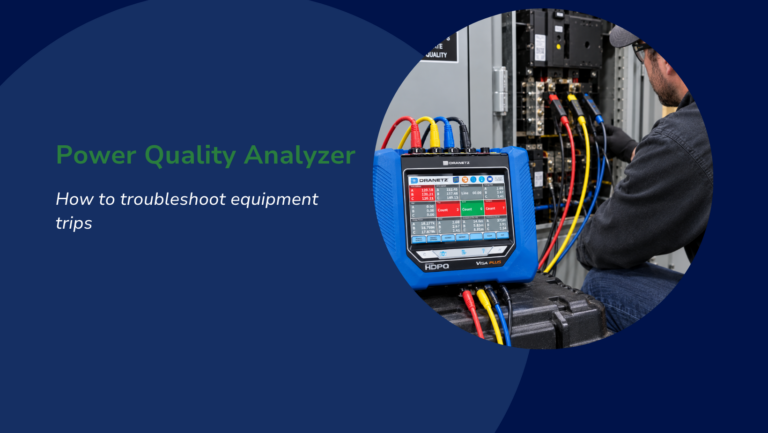
When industrial equipment shuts down unexpectedly, the cause is not always obvious. A VFD may trip without an apparent fault. A PLC may reset. A breaker may trip intermittently. A motor may shut down in the middle of production.
These problems can be difficult to diagnose because the electrical disturbance causing the shutdown may only last for a fraction of a second.
That is where a power quality analyzer can help.
A power quality analyzer can help identify the electrical conditions causing equipment trips by continuously monitoring voltage, current, harmonics, transients, sags, swells, and interruptions.
For facilities experiencing recurring equipment trips, power quality monitoring can provide the data needed to identify what is actually happening on the electrical system.
Table of Contents
Why Equipment Trips Can Be Difficult to Troubleshoot
Many electrical problems are intermittent. By the time an electrician arrives at the equipment, everything may be operating normally.
For example:
- A VFD trips once every few hours.
- A PLC resets randomly during production.
- A motor shuts down with no obvious mechanical problem.
- A breaker trips only when another piece of equipment starts.
- Control equipment loses power for a fraction of a second.
Checking voltage with a handheld meter after the problem occurs may not reveal anything unusual.
A power quality analyzer, however, can continuously monitor the electrical system and capture events when they happen.
Using a Power Quality Analyzer to Troubleshoot VFD Trips
Variable frequency drives (VFDs) are sensitive to certain power quality conditions. If a drive repeatedly trips, the fault code can provide a clue, but it may not identify the underlying electrical problem.
A power quality analyzer can help determine whether the VFD is experiencing:
- Voltage sags
- Voltage swells
- Transient events
- Voltage imbalance
- Harmonic distortion
- Frequency variations
- Overcurrent conditions
- Interruptions or momentary power losses
For example, if a VFD reports an undervoltage fault, monitoring the incoming power can determine whether the supply voltage actually dropped when the trip occurred.
This helps distinguish between a problem with the drive itself and a problem originating elsewhere in the electrical system.
Troubleshooting PLC Resets
PLCs and other control equipment can be particularly difficult to troubleshoot because a very short interruption in power may be enough to cause a reset.
A power quality analyzer can monitor the voltage feeding the control system and capture events that may otherwise go unnoticed.
When investigating PLC resets, look for:
- Momentary voltage interruptions
- Voltage sags
- Transients
- Poor voltage regulation
- Loose or unstable connections
- Neutral problems
- Electrical disturbances caused by nearby equipment
If the analyzer records a voltage event at the exact time the PLC resets, you have a much stronger starting point for finding the source of the problem.
Investigating Breakers That Keep Tripping
A power quality analyzer can measure current over time to help determine what is happening immediately before the breaker trips.
Depending on the application, useful measurements may include:
- RMS current
- Peak current
- Inrush current
- Voltage
- Frequency
- Voltage and current waveforms
Monitoring the system while equipment starts and stops can be particularly useful when a breaker only trips under certain operating conditions.
Troubleshooting Motors That Shut Down Unexpectedly
A power quality analyzer can measure current over time to help determine what is happening immediately before the breaker trips.
Depending on the application, useful measurements may include:
- RMS current
- Peak current
- Inrush current
- Voltage
- Frequency
- Voltage and current waveforms
Monitoring the system while equipment starts and stops can be particularly useful when a breaker only trips under certain operating conditions.
What Should You Measure?
The measurements you need depend on the equipment and the symptoms, but a good power quality troubleshooting investigation may include:
Voltage
Monitor voltage on each phase to identify sags, swells, interruptions, and abnormal voltage levels.
Current
Current measurements can reveal overloads, inrush conditions, imbalance, and unusual changes in equipment demand.
Frequency
Frequency variations can indicate problems with the electrical supply or generation system.
Harmonics
Nonlinear loads such as VFDs, UPS systems, switching power supplies, and other electronic equipment can introduce harmonic distortion into an electrical system.
Transients
Short-duration voltage disturbances may be difficult to capture with a standard multimeter. A power quality analyzer can record these events so they can be analyzed after the fact.
Voltage and Current Waveforms
Waveform capture can provide additional information about what the electrical system looked like during an abnormal event.
How Long Should You Monitor?
The right monitoring period depends on how frequently the equipment trips.
If the equipment trips several times per day, a few hours of monitoring may be enough to capture an event.
If the problem happens once every few days, monitoring for several days may be necessary.
A useful rule is:
Monitor long enough to capture the problem.
For intermittent equipment trips, leaving the power quality analyzer connected during normal production is often more useful than taking measurements only after the equipment has already failed.
How Does a Power Quality Analyzer Capture Intermittent Problems?
One of the biggest advantages of a power quality analyzer is its ability to monitor continuously and record events automatically.
Instead of watching a meter and waiting for something to happen, the analyzer can monitor the electrical system while the facility operates normally.
When the measured values cross defined thresholds, the analyzer can record information about the event.
For example, an analyzer may capture:
Normal operation → Voltage sag occurs → Equipment trips → Analyzer records event
You can then review the recorded data to determine what happened immediately before and during the equipment trip.
This is especially valuable when the problem occurs in the middle of the night or only happens when specific equipment is operating.
A Practical Power Quality Troubleshooting Process
When troubleshooting recurring equipment trips, start with the symptoms and work backward.
1. Identify the equipment that is failing.
Determine whether you are troubleshooting a VFD, PLC, motor, breaker, control system, or other equipment.
2. Document the symptoms.
Record fault codes, approximate trip times, operating conditions, and what equipment was running when the problem occurred.
3. Determine where to connect the analyzer.
Depending on the suspected cause, monitoring may need to take place at the equipment, panel, MCC, distribution point, or incoming electrical service.
4. Configure the analyzer.
Set appropriate thresholds and recording parameters for the problem you are investigating.
5. Monitor during normal operation.
Allow the analyzer to collect data while the facility operates normally.
6. Review the recorded events.
Look for electrical disturbances that occurred at or immediately before the equipment shutdown.
7. Identify the source.
Once the electrical event has been identified, additional troubleshooting can help determine what equipment or part of the electrical system caused it.
Don't Guess at Electrical Problems. Measure Them.
Replacing a VFD, PLC, motor, breaker, or other component may temporarily appear to solve an equipment trip, but if the underlying power quality problem remains, the replacement equipment could experience the same issue.
A power quality analyzer gives you actual electrical data instead of relying solely on assumptions.
Whether you are investigating VFDs tripping, PLCs resetting, breakers tripping, motors shutting down, or other unexpected equipment shutdowns, power quality monitoring can help identify intermittent electrical problems that are otherwise difficult to find.
Rent a Power Quality Analyzer from Lakeland
Don’t wait for an intermittent electrical problem to happen while you’re standing next to the equipment.
Lakeland Engineering offers power quality analyzer rentals for troubleshooting industrial electrical systems. Renting an analyzer allows you to monitor equipment over the period necessary to capture intermittent power quality problems without purchasing equipment for a one-time investigation.
Need to troubleshoot an equipment trip? Rent a power quality analyzer from Lakeland Engineering and get the data you need to find the problem.