

Industrial Ethernet switches are a critical part of modern automation networks, connecting PLCs, HMIs, drives, sensors, remote I/O, computers, and other devices so they can communicate reliably.
But when selecting an industrial Ethernet switch, one of the first questions you may encounter is:
Do I need a managed or unmanaged switch?
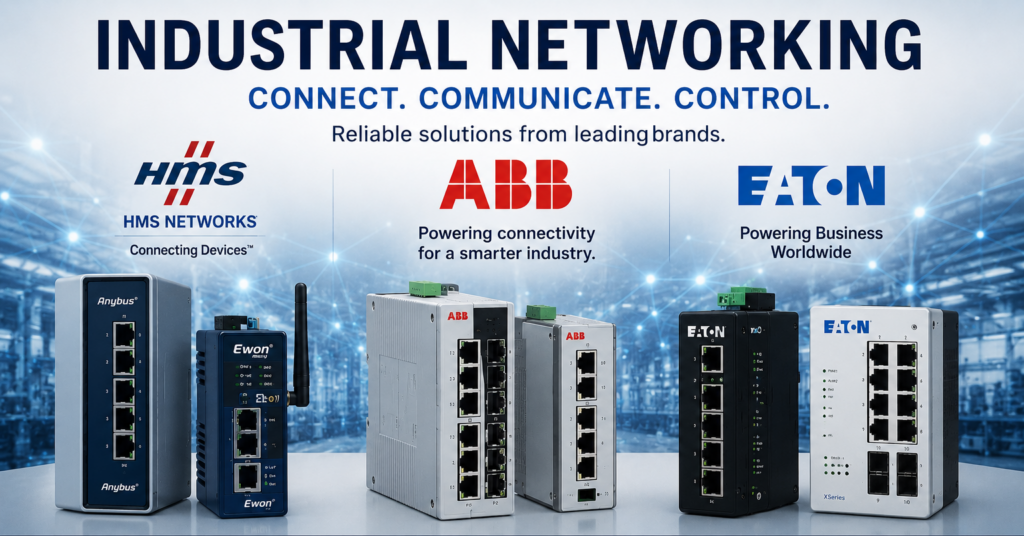
The answer depends on the size and complexity of your network, how much control and visibility you need, and how important network redundancy, diagnostics, security, and uptime are to your application.
In this guide, we’ll explain the difference between managed and unmanaged industrial Ethernet switches and help you determine which option is right for your application.
What Is an Industrial Ethernet Switch?
An Ethernet switch connects multiple devices on an Ethernet network and directs data between them. In an industrial environment, switches are designed to handle conditions that standard commercial networking equipment may not, including vibration, electrical noise, temperature extremes, and demanding uptime requirements.
Industrial Ethernet switches are commonly used to connect equipment such as:
- PLCs and PACs
- HMIs
- Variable frequency drives (VFDs)
- Remote I/O
- Industrial PCs
- Sensors and other automation devices
- SCADA systems
- Cameras and other Ethernet-connected equipment
Industrial Ethernet switches are available in both managed and unmanaged configurations, with each offering different levels of network control.
What Is the Difference Between Managed and Unmanaged Switches?
What Is an Unmanaged Industrial Ethernet Switch?
An unmanaged Ethernet switch is a plug-and-play networking device that requires little or no configuration.
Simply connect the Ethernet cables and the switch begins forwarding network traffic between connected devices.
Because unmanaged switches are designed for simplicity, they are often a good fit for smaller, straightforward machine networks where advanced network monitoring or configuration isn’t required.
An unmanaged switch may be the right choice when:
- You have a small, simple machine network.
- The network configuration is unlikely to change.
- You don’t need remote network monitoring.
- Advanced diagnostics aren’t necessary.
- Network redundancy isn’t required.
- Keeping installation simple and cost-effective is a priority.
For example, a machine builder may use an unmanaged switch inside a machine panel to connect a PLC, HMI, VFD, and remote I/O devices.
If the network is relatively small and stable, there may be little benefit to paying for advanced management capabilities.
What Is a Managed Industrial Ethernet Switch?
A managed Ethernet switch provides the same fundamental switching function as an unmanaged switch but adds configuration, monitoring, diagnostic, redundancy, and other network-management capabilities.
Instead of simply plugging the switch in and letting it operate, a managed switch allows network administrators or automation professionals to configure how network traffic is handled and monitor network performance.
A managed switch is typically a better choice when your network:
- Has many connected devices.
- Requires high availability.
- Needs network redundancy.
- Requires network monitoring or diagnostics.
- Needs traffic prioritization.
- Is expected to grow or change.
- Requires network segmentation.
- Has cybersecurity requirements.
- Supports critical production equipment.
The biggest difference is control.
An unmanaged switch provides basic connectivity without requiring the user to configure or monitor the network.
A managed switch gives you tools to configure, monitor, diagnose, and optimize the network.
Think of it this way:
Unmanaged = connect it and go.
Managed = connect it, configure it, monitor it, and control how the network operates.
That doesn’t mean a managed switch is automatically better. It means it provides more capabilities—and those capabilities are valuable when your application actually needs them.
Can You Use Both Managed and Unmanaged Switches?
Yes.
Industrial networks don’t necessarily have to use only managed or only unmanaged switches.
Depending on the network design, both can be used in different areas of a system.
For example, a larger facility might use managed switches for the plant backbone and critical network infrastructure while using simpler unmanaged switches within individual machines.
The right approach depends on the network architecture, application requirements, and the level of visibility and control needed at each location.
5 Questions to Ask When Choosing an Industrial Ethernet Switch
How large is the network?
A small machine network with only a few devices may not require advanced management capabilities.
As the number of devices and network connections increases, however, monitoring and network-management capabilities become increasingly valuable.
How important is uptime?
If a network interruption can stop a production line, managed-switch features such as redundancy and network diagnostics may be worth considering.
Managed switches can support redundancy mechanisms that help maintain communication when a network connection or device fails, depending on the network architecture and switch capabilities.
Do you need network diagnostics?
Troubleshooting can be much easier when you can see what’s happening on the network.
Managed switches may provide information such as port status, traffic statistics, events, and other diagnostic information.
Instead of simply knowing that a device isn’t communicating, network personnel may be able to determine whether a port, connection, or traffic condition is contributing to the problem.
Do you need network segmentation or traffic prioritization?
Larger industrial networks may need to separate network traffic or prioritize certain types of communication.
Managed switches can offer features such as VLANs and Quality of Service (QoS), depending on the model.
These capabilities can help engineers design networks around the requirements of the application.
Will the network grow?
If you’re installing a network that may expand in the future, it may be worth considering a managed switch from the beginning.
A managed switch can provide additional flexibility as the network becomes more complex.
Need Help Selecting an Industrial Ethernet Switch?
Choosing the right industrial Ethernet switch can be challenging when you have to consider port count, network speed, protocols, redundancy, environmental conditions, mounting requirements, and managed versus unmanaged functionality.
Lakeland Engineering Equipment Company can help you find the right industrial networking solution for your application.
Explore Lakeland’s Industrial Networking solutions or contact our team for help selecting the right switch and networking components for your application.