
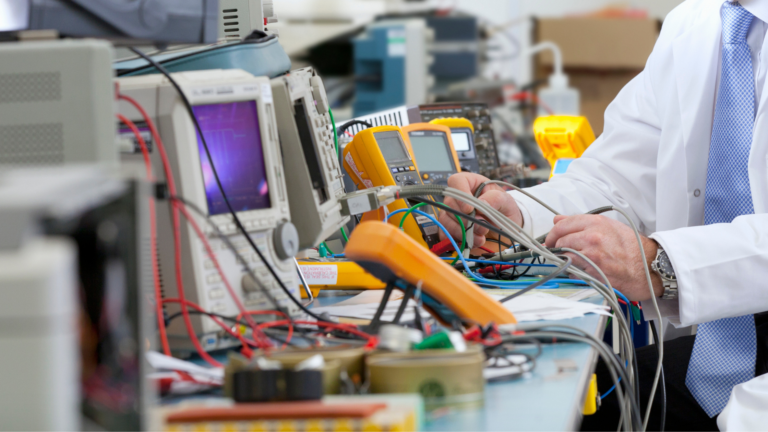
Every maintenance engineer and electrical contractor eventually faces the same decision. A job requires an oscilloscope, and the equipment budget has to answer one question: rent or buy?
The right answer depends on how often the scope will be used, what bandwidth and channel count the job demands, and how fast the equipment needs to be on-site. Here is how to think through the decision.
What Oscilloscope Rental Actually Costs
Oscilloscope rental gives a facility access to current, calibrated test equipment without a capital purchase. Monthly rental rates for a mid-range digital storage oscilloscope typically run a small fraction of the unit’s purchase price, and the equipment arrives calibrated and ready to deploy.
Rental also removes the ownership burden. Calibration, firmware updates, storage, and eventual disposal all become someone else’s responsibility. For a one-time troubleshooting job, a short-term commissioning project, or a seasonal maintenance push, that arrangement keeps cash on hand for other priorities.
The tradeoff is availability. A rental oscilloscope needs to be reserved and shipped, and popular models can be booked out during peak maintenance seasons. Planning ahead matters.
What Buying an Oscilloscope Actually Costs
Purchasing an oscilloscope means a fixed upfront cost, followed by ongoing costs that many buyers underestimate. Annual calibration runs several hundred dollars per unit. Firmware and software licenses sometimes carry renewal fees. Probes, batteries, and accessories wear out and need replacement. And the scope itself depreciates as newer bandwidth and channel options come to market.
Ownership pays off when the scope gets consistent use. A facility running daily motor diagnostics, power quality checks, or control system troubleshooting will use a purchased oscilloscope enough to justify the investment within a year or two. The scope is always on hand, technicians build familiarity with one interface, and there is no dependency on a rental schedule.
Rental vs. Buying: Side-by-Side Comparison
| Factor | Oscilloscope Rental | Buying an Oscilloscope |
| Upfront cost | Low, monthly or short-term rate | High, full purchase price |
| Calibration | Handled by rental provider | Owner’s responsibility, annual cost |
| Access to latest models | Easy to upgrade between jobs | Requires new purchase to upgrade |
| Best for | Short-term projects, one-time diagnostics, seasonal work | Daily or weekly use, in-house test labs |
| Storage and maintenance | Not required | Required |
| Lead time | Shipping or pickup required | Immediate, once owned |
When Renting Makes Sense
A rental oscilloscope is the stronger option in a few common scenarios.
One-time or infrequent testing. A single commissioning project, a warranty investigation, or a one-off troubleshooting call rarely justifies a purchase.
Specialized bandwidth needs. A job that calls for a high-bandwidth or high-channel-count scope outside the facility’s normal work is a strong candidate for rental. Buying a specialty unit that sits idle after one project ties up capital for no ongoing benefit.
Tight project timelines with uncertain future need. When a facility does not yet know if a given test requirement will recur, renting keeps options open without a long-term commitment.
Peak season overflows. Facilities that see a spike in testing demand during certain months can rent additional units rather than owning equipment that sits unused the rest of the year.
When Buying Makes Sense
Purchasing an oscilloscope earns its cost back under different conditions.
Recurring, predictable use. Facilities running regular diagnostics on motors, drives, and control panels get more value from an owned scope with every use.
In-house test and calibration labs. A dedicated lab needs equipment on hand at all times, without waiting on a rental schedule.
Training and standardization goals. Technicians who work on the same scope daily develop faster, more consistent diagnostic habits than those switching between rental units.
Long-term budget planning. Facilities that can spread a purchase across a capital budget, rather than an operating budget, often find ownership fits their financial structure better.
Questions to Ask Before Deciding
Before choosing a path, walk through these questions with the team:
- How many times per year will this oscilloscope actually be used?
- Does the job require a specific bandwidth or channel count the facility does not already own?
- Who will handle calibration and maintenance if the unit is purchased?
- How quickly does the equipment need to be on-site?
- Is this a recurring test requirement or a one-time need?
Answering these honestly usually makes the decision clear. Frequent, predictable use points toward buying. Occasional or specialized use points toward renting.
Get the Right Test Equipment for the Job
Lakeland Engineering Equipment Company has spent more than seventy years helping manufacturers, contractors, and facility teams get the right electrical components and test equipment for the job in front of them.
Our oscilloscope rental program gives your team access to calibrated, ready-to-use equipment without the cost and upkeep of ownership, backed by the same customer service Lakeland customers have counted on for generations.
Need a rental oscilloscope for your next project, or want help deciding whether renting or buying makes more sense for your operation? Talk to Lakeland and let our team help you find the right fit.