- Supplier Products
How Schneider Electric Drives Transform Motor Control Performance Across Industries
- By Marketing
How Schneider Electric Drives Transform Motor Control Performance Across Industries
In industrial automation, motors are everywhere, moving materials, controlling flow, powering production lines, and keeping critical systems running. But the way those motors are controlled plays a major role in efficiency, reliability, and long-term equipment health.
That’s where Schneider Electric drives come in. Rather than simply turning motors on and off, Schneider Electric drives allow operators to control speed, torque, and acceleration with precision. Across industries, that control translates into better performance, lower energy consumption, and reduced wear on equipment.
Moving Beyond Basic Motor Control
Traditional motor starting methods apply full voltage immediately, creating high inrush current and mechanical stress. A Schneider Electric drive manages motor startup and operation more intelligently by ramping speed and continuously adjusting output to match process demand.
This becomes especially important in applications like conveyors, pumps, fans, compressors, and mixers, where load conditions change throughout the day. Instead of running at full speed constantly, a Schneider Electric drive allows motors to operate only as fast as needed.
Matching the Right Schneider Electric Drive to the Application
Not all Schneider Electric drives are designed for the same environments or performance requirements. Choosing the right drive of family is critical to long-term reliability.
For example:
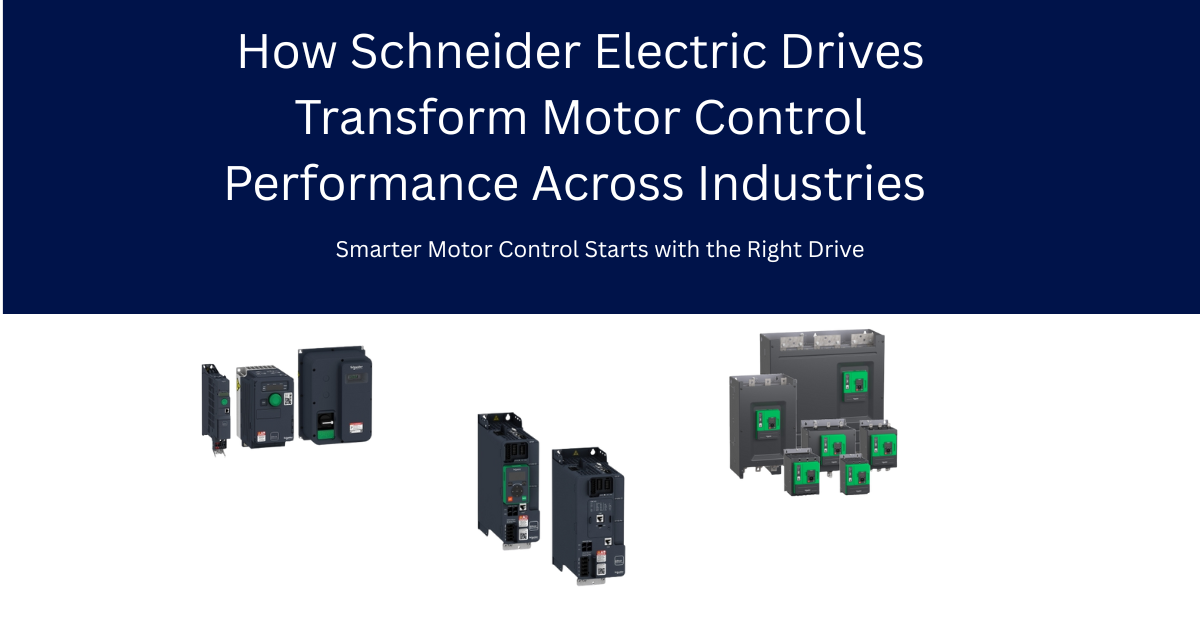
Schneider Altivar 12 (ATV12) drives are commonly used for simple machines such as small conveyors, packaging equipment, and light-duty automation. A part number like ATV12H075M2 may work well in a clean, ventilated panel with intermittent duty, but in high ambient temperatures or continuous operation, that same drive could run hotter than desired.
For more demanding applications, Schneider Altivar 320 (ATV320) drives are designed for industrial-duty environments. Models such as ATV320U07M2C offer better thermal performance, higher overload capability, and improved reliability for continuous operation, making them well suited for material handling, pumps, and fans.
In higher horsepower or more complex applications, Schneider Altivar 630 and 660 (ATV630 / ATV660) drives are commonly used in process industries like water and wastewater, HVAC, and energy-intensive systems. These drives are built to handle heavier loads, advanced diagnostics, and harsh operating conditions without overheating or derating.
Energy Efficiency and Process Stability
Energy consumption is a major concern in most industrial facilities, and motors often account for a large portion of electrical load. By adjusting motor speed to real-time demand, Schneider Electric drives help reduce wasted energy, particularly in variable-torque applications such as pumping and ventilation systems.
Schneider Electric drives also improve process stability. Controlled acceleration and deceleration reduce pressure surges, eliminate mechanical shock, and help extend the life of motors, gearboxes, and connected equipment.
Built for Industrial Environments
Schneider Electric drives are engineered to operate reliably in demanding conditions, including temperature fluctuations, continuous duty cycles, and electrically noisy environments. Many models include built-in protection features such as overload monitoring, fault diagnostics, and communication options for integration with PLCs and plant networks.
These features give maintenance teams greater visibility into system health and allow potential issues to be identified before they result in downtime.
Flexibility Across Industries
One of the strengths of Schneider Electric drives is their adaptability across industries, including manufacturing, food and beverage, water and wastewater, material handling, and infrastructure. With multiple drive families, frame sizes, voltage ratings, and communication options, Schneider Electric drives can be tailored to both new installations and retrofit projects.
Whether the goal is improving efficiency, increasing process control, or reducing maintenance costs, there is a Schneider Electric drive designed for the job.
Local Support Makes the Difference
Selecting the correct Schneider Electric drive involves more than horsepower and voltage. Load type, duty cycle, ambient temperature, enclosure design, and communication requirements all play a role.
Lakeland Engineering supports Schneider Electric drive solutions through our Minneapolis and Kansas locations, helping customers evaluate real-world operating conditions and select drives that won’t overheat, derate, or fail prematurely. Local expertise ensures systems are designed correctly the first time.
A Smarter Approach to Motor Control
Modern motor control is about optimizing how equipment operates every day, not just getting it to run. Schneider Electric drives give engineers and operators the control, efficiency, and reliability needed to support today’s industrial demands.
When performance, uptime, and long-term system health matter, choosing the right Schneider Electric drive makes all the difference.