- Product Spotlight, Supplier Products
Standardizing Motor Control with Schneider Electric: Why Consistency Matters in Industrial Facilities
- By Emily Hagel
In many industrial facilities, motor control systems develop incrementally rather than intentionally. New equipment is added to meet production goals, legacy machines are retrofitted to extend service life, and replacement components are chosen based on availability or project timelines. Over time, this leads to a mix of drives, starters, and control philosophies supporting similar applications.
What begins as flexibility often becomes fragmentation. Similar motors may behave differently, require different service procedures, or rely on different software tools. These differences are rarely documented centrally, creating hidden operational risk that grows as facilities expand and staff changes occur.
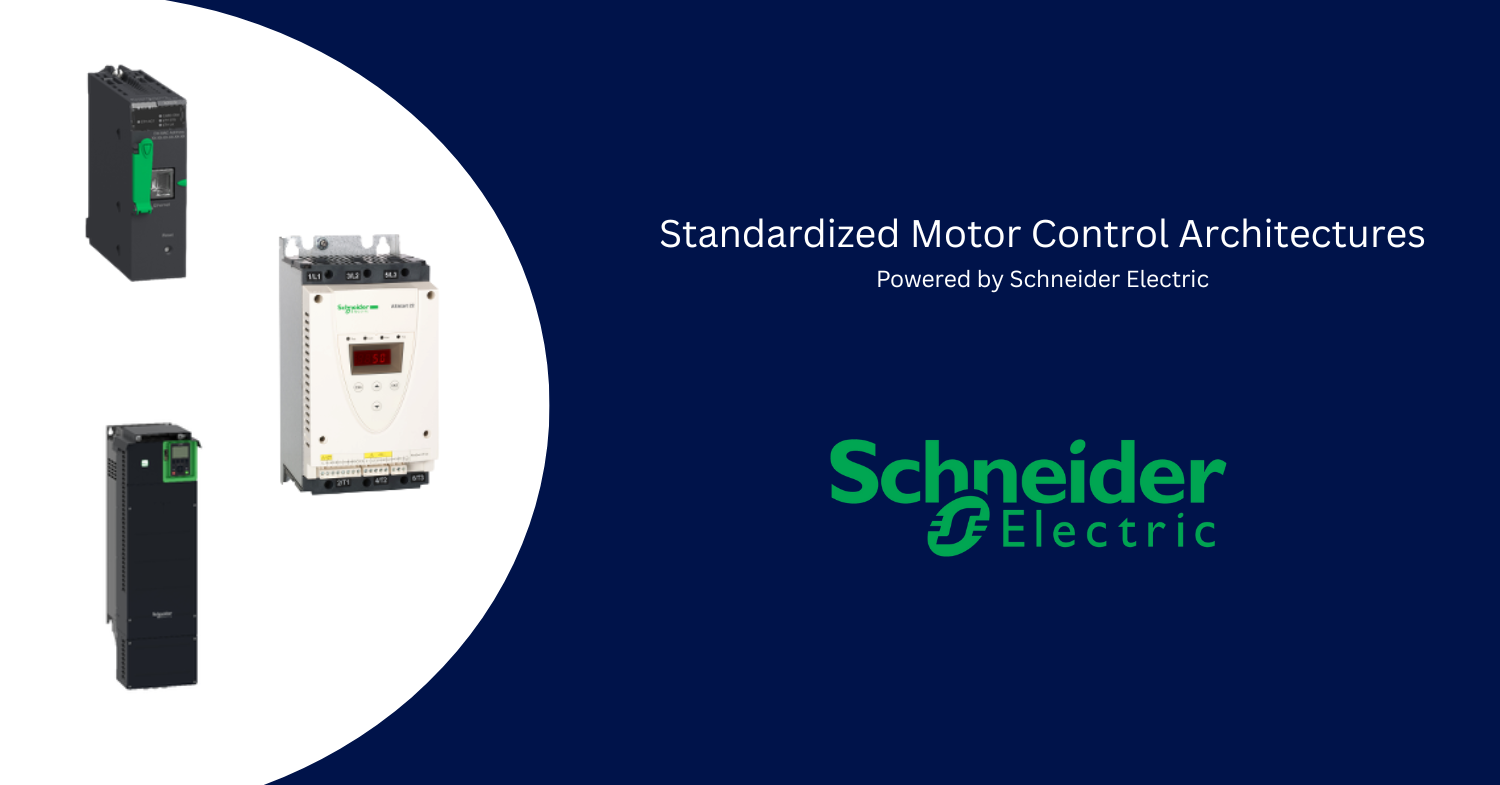
To address this, many facilities choose to standardize motor control using Schneider Electric solutions. Standardization establishes a common framework for control, diagnostics, maintenance, and future expansion, enabling facilities to transition from reactive problem-solving to a more resilient, long-term automation strategy.
The Hidden Cost of Inconsistent Motor Control
Inconsistent motor control increases complexity at every level of operation. Maintenance teams must understand multiple parameter structures, fault codes, and commissioning procedures. Even experienced technicians can lose valuable time navigating unfamiliar platforms when responding to an issue.
Beyond maintenance inefficiency, inconsistency introduces operational variability. Drives with different overload classes, thermal models, or control algorithms may respond differently to the same load conditions. This can result in uneven acceleration, nuisance trips, or subtle mechanical stress that reduces equipment life over time.
These challenges often remain hidden until demand increases or a failure occurs. At that point, troubleshooting takes longer, downtime extends, and the cost of inconsistency becomes measurable, not just in repair expenses, but in lost production and strained resources.
Simplifying Maintenance and Troubleshooting
Standardizing on Schneider Electric motor control solutions allows maintenance teams to work within a familiar, repeatable environment. When drives and starters share similar configuration methods, diagnostic structures, and fault messaging, technicians can approach issues methodically rather than relying on trial and error.
This consistency improves troubleshooting speed and accuracy. Common fault conditions can be recognized quickly, corrective actions become standardized, and documentation can be reused across systems. As a result, downtime is reduced, and corrective maintenance becomes more predictable.
Over time, standardization also strengthens knowledge transfer. Best practices can be formalized, training becomes more efficient, and facilities become less dependent on a few individuals with specialized platform knowledge, thereby reducing long-term operational risk.
Consistent Performance Across Applications
Process consistency depends heavily on predictable motor behavior. When similar motors are controlled by different platforms, variations in acceleration, torque response, and protection settings can affect process stability and equipment wear.
Schneider Electric motor control solutions are designed to deliver consistent performance across a wide range of applications. By applying standardized control strategies, facilities can achieve uniform response across conveyors, pumps, fans, and process equipment.
This consistency reduces mechanical stress, improves energy efficiency, and supports repeatable process outcomes. In environments where uptime, quality, or throughput are critical, predictable motor behavior becomes a foundational requirement rather than a convenience.
Supporting Long-Term System Growth
As facilities expand or modify operations, inconsistent motor control platforms complicate integration. New equipment may require additional engineering effort to interface with existing systems, increasing project timelines and costs.
Standardized motor control simplifies expansion by maintaining compatibility across new and existing assets. Engineers can reuse proven configurations, apply consistent control philosophies, and integrate new equipment without introducing unnecessary complexity.
Because Schneider Electric motor control integrates seamlessly with PLCs, HMIs, and power monitoring systems, standardization supports scalable growth while maintaining architectural consistency across the facility.
Long-Term Support and Lifecycle Confidence
Lifecycle uncertainty is one of the greatest risks in fragmented motor control environments. Different platforms reach end-of-life at different times, forcing unplanned upgrades and increasing the likelihood of unsupported components remaining in service.
Schneider Electric provides clear lifecycle visibility, product roadmaps, and ongoing investment in motor control technologies. This transparency allows facilities to plan upgrades strategically rather than reacting to sudden obsolescence.
With a standardized platform, lifecycle planning becomes proactive. Facilities can phase upgrades, align budgets, and maintain operational continuity, reducing long-term risk and improving confidence in system supportability.
Local Expertise Makes Standardization Successful
While standardization offers clear advantages, successful implementation depends on proper application knowledge. Load characteristics, duty cycles, environmental conditions, and operational priorities all influence motor control design.
Lakeland Engineering supports Schneider Electric motor control solutions through our Minneapolis and Kansas locations, helping facilities assess existing systems and identify practical standardization opportunities. This includes evaluating legacy equipment, aligning control strategies, and selecting solutions that fit real-world operating conditions.
Local expertise ensures standardization efforts are not only technically sound but operationally sustainable, supporting long-term reliability rather than creating new constraints.
View our full Schneider Electric product line:
Why Consistency Pays Off
Consistency in motor control reduces uncertainty across maintenance, operations, and planning. Systems become easier to support, troubleshooting becomes faster, and long-term decisions become more predictable.
Over time, standardized motor control environments deliver measurable benefits: reduced downtime, lower maintenance burden, improved system reliability, and greater confidence in future expansion.
For industrial facilities looking to simplify operations and strengthen long-term performance, standardizing on Schneider Electric motor control solutions provides a durable foundation for sustained success.