
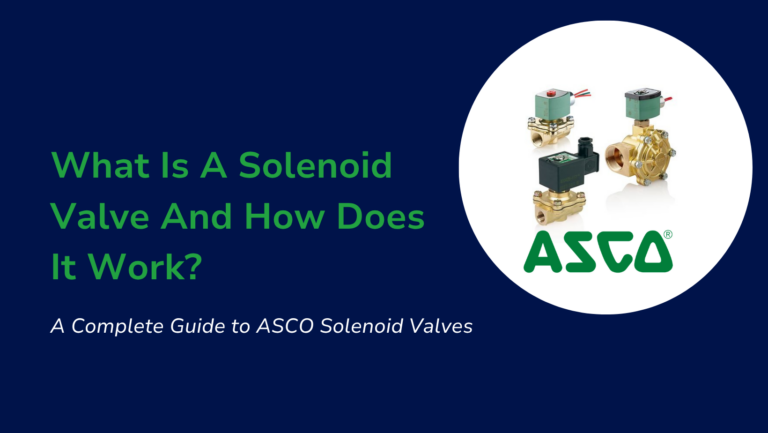
A solenoid valve is an electrically controlled valve used to start, stop, or direct the flow of liquids and gases. Found throughout industrial automation, manufacturing, process equipment, HVAC systems, and fluid control applications, solenoid valves provide a reliable way to control media without requiring manual operation.
For companies looking for dependable industrial fluid control, ASCO solenoid valves are a widely used solution. ASCO offers a broad range of solenoid valves designed for applications involving air, water, steam, gases, oils, and other media.
Lakeland Engineering Equipment Company supplies ASCO products and can help customers select the right solenoid valve based on application requirements, media, pressure, temperature, voltage, and connection type.
What Is a Solenoid Valve And How Does It Work?
A solenoid valve is an electromechanical device that uses an electrical signal to control the movement of a valve.
The word solenoid refers to the electromagnetic coil that creates a magnetic field when electrical current passes through it. That magnetic force moves a plunger or other internal component, causing the valve to open, close, or change flow paths.
Electrical signal → Electromagnetic force → Valve movement → Fluid or gas flow is controlled
This makes solenoid valves particularly useful in automated systems where valves need to be controlled remotely or repeatedly.
When the valve receives an electrical signal, the coil generates a magnetic field. The magnetic field moves the armature, which changes the position of the valve.
Depending on the valve design, energizing the coil may either open or close the flow path.
When electrical power is removed, a spring or other mechanism typically returns the valve to its normal position.


ASCO Solenoid Valves
ASCO, an Emerson brand, is one of the most recognized names in industrial fluid control. ASCO solenoid valves are used in a wide variety of industries and applications where reliable control of liquids and gases is required.
One of the advantages of ASCO’s extensive valve portfolio is the ability to select a valve specifically suited to the application rather than trying to use one valve for every situation.
Common Types of Solenoid Valves
One of the most common distinctions is between normally closed and normally open valves.
A normally closed (NC) valve remains closed when the coil is not energized and opens when power is applied. A normally open (NO) valve does the opposite—it remains open without power and closes when energized.
The right configuration depends on how the system should operate and, importantly, how the valve should respond if electrical power is lost.
Solenoid valves can also be 2-way or 3-way. A 2-way valve controls flow between an inlet and outlet, while a 3-way valve can divert or direct flow between multiple ports.
Another important distinction is between direct-acting and pilot-operated valves. Direct-acting valves use the solenoid to directly control the valve opening, while pilot-operated valves use system pressure to assist with operation. The appropriate design depends on factors such as pressure and flow requirements.
How Do You Select the Right ASCO Solenoid Valve?
Selecting a solenoid valve requires more than matching the pipe size. The valve needs to be compatible with the application and operating conditions.
Start by identifying the media being controlled, such as air, water, steam, oil, or gas. Then consider the system’s pressure, temperature, required flow rate, electrical voltage, connection size, and valve configuration.
For example, a valve used for steam will have different requirements than one used for compressed air. Similarly, a valve operating in a high-temperature or high-pressure environment may require a different construction than one used in a general-purpose application.
ASCO offers a wide range of valve options, making it possible to select a solution based on these specific requirements.
Common Solenoid Valve Applications
Solenoid valves are used anywhere automated control of liquids or gases is required. Manufacturing equipment may use them to control compressed air, water, or other process fluids. HVAC systems use solenoid valves for fluid and refrigerant control, while pneumatic equipment uses them to control air flow to cylinders and actuators.
They are also found in water and wastewater equipment, food and beverage processing, energy applications, and many other industrial systems.
Solenoid Valve Troubleshooting
When a solenoid valve isn’t working properly, the problem may be electrical, mechanical, or related to the system itself.
A valve that won’t open could have an incorrect or missing electrical signal, a failed coil, contamination, or insufficient pressure. A valve that won’t close or continues to leak could have damaged seals, debris inside the valve, or an internal mechanical problem.
Before replacing a valve, it’s important to determine the cause of the failure. If an ASCO valve needs to be replaced, the existing model number and nameplate information can help identify the correct replacement.
Need Help Selecting an ASCO Solenoid Valve?
Choosing the right solenoid valve requires matching the valve to the application’s media, pressure, temperature, flow, voltage, and connection requirements.
Lakeland Engineering Equipment Company can help you identify the right ASCO solenoid valve for your application, whether you’re replacing a failed valve, designing new equipment, or looking for a solution for an existing system.
Contact Lakeland Engineering to learn more about ASCO solenoid valves and other industrial fluid control solutions.