- Product Spotlight
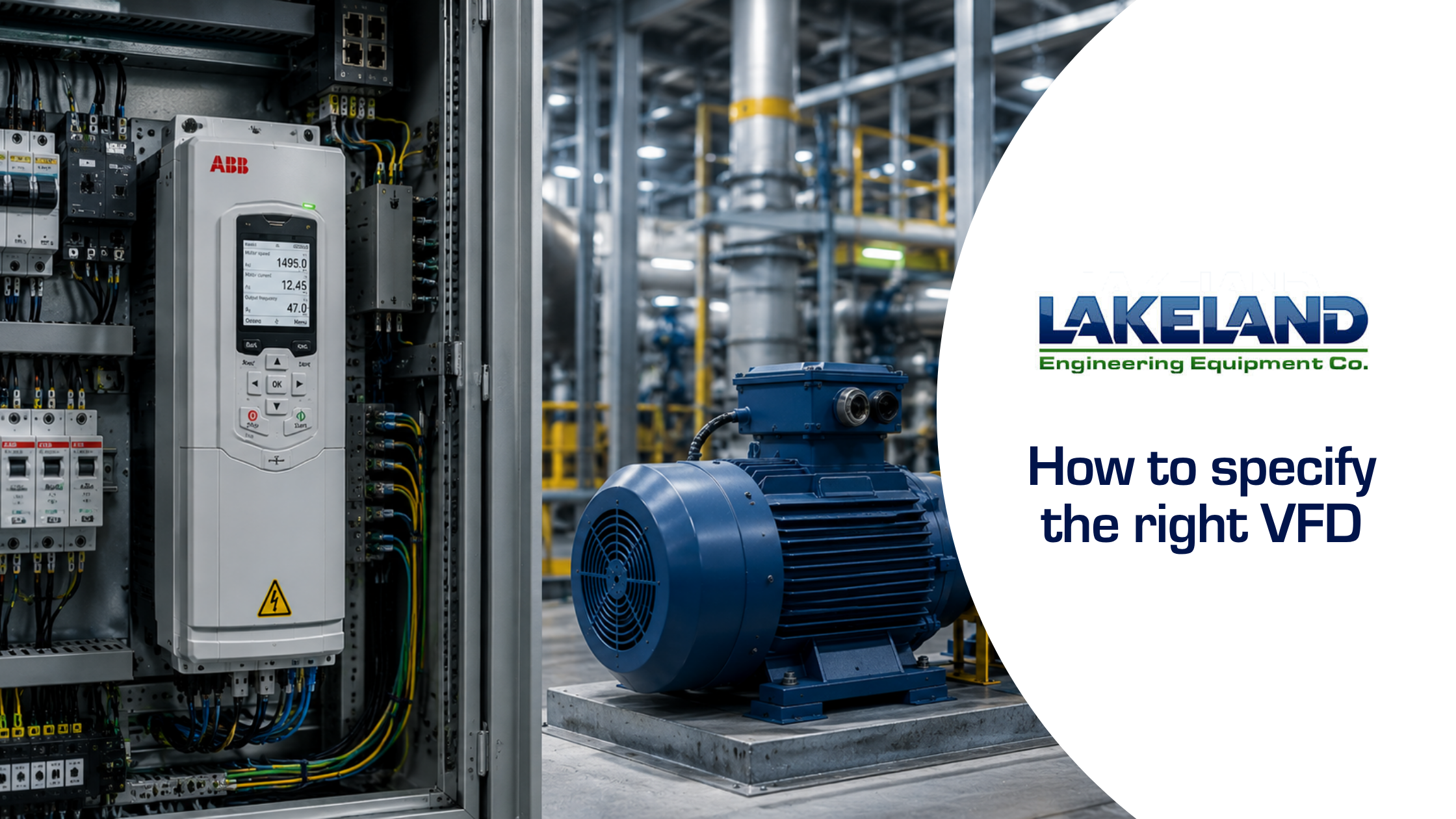
ABB Variable Frequency Drive: How to Specify the Right VFD During the Design Phase
- By Marketing
Industrial facilities depend on motors. Pumps, fans, compressors, conveyors, mixers, and material handling systems all rely on motor-driven equipment to keep production moving. That makes the variable frequency drive, or VFD, a design-phase decision with long-term impact.
For OEM machine builders, electrical contractors, control panel shops, and plant engineering teams, an ABB variable frequency drive can support tighter motor control, lower energy consumption, smoother startup, and better system reliability. The key is specifying the right drive before the panel is built, the equipment is installed, or the project reaches commissioning.
Why ABB VFDs matter in manufacturing applications
An ABB variable frequency drive controls the speed and torque of an AC motor by adjusting frequency and voltage. Instead of running a motor at full speed and using dampers, valves, or mechanical throttling to control output, the drive lets the motor match the actual load.
That matters in common industrial applications:
| Application | Design-phase VFD value |
| Pumps | Reduces wasted energy from throttling, supports soft start, and helps manage flow |
| Fans | Matches airflow demand, reduces mechanical stress, and supports quieter operation |
| Compressors | Improves process control and reduces hard-start impact |
| Conveyors | Supports controlled acceleration, deceleration, and product handling |
| Mixers | Helps tune speed for process consistency |
| HVACR systems | Integrates with building automation and supports energy-efficient operation |
The business case starts with load profile
The best VFD specification starts with the load. A drive selected only by horsepower can miss critical requirements. Engineers should confirm whether the application is variable torque, constant torque, or high overload.
Variable torque loads include fans and centrifugal pumps. These applications often provide the strongest energy savings because power demand drops significantly when speed is reduced.
Constant torque loads include conveyors, mixers, positive displacement pumps, and many material handling systems. These applications need a drive selected for torque performance, overload capacity, and duty cycle.
High-demand applications may require added attention to braking, harmonics, enclosure rating, temperature, motor cable length, and communication needs.
ABB reported in 2025 that its appraisals of more than 5,900 industrial electric motor-driven systems identified average energy savings of 43%. ABB also states that variable-speed drives typically reduce power consumption by 25% by matching motor speed and torque to load requirements. (ABB Group)
ABB VFD selection checklist
During design, confirm these items before quoting or building the control panel:
| Selection factor | What to confirm |
| Motor horsepower and full-load amps | Size the VFD by current, not horsepower alone |
| Input voltage and phase | Match facility power and motor requirements |
| Load type | Identify variable torque, constant torque, or high overload |
| Enclosure rating | Match the installation environment, including dust, washdown, heat, or outdoor exposure |
| Communications | Confirm Ethernet/IP, Modbus, BACnet, or other required protocols |
| Bypass needs | Determine whether the application needs a bypass for service continuity |
| Harmonic requirements | Review facility standards, utility requirements, and sensitive equipment |
| Safety requirements | Confirm safe torque off, disconnects, fusing, and panel standards |
| Service access | Plan keypad access, clearance, replacement strategy, and troubleshooting needs |
Where projects go wrong
Most VFD problems start before startup. Common issues include undersized drives, wrong enclosure selection, long motor leads without proper mitigation, poor grounding, inadequate cooling, and missing communication requirements.
Commissioning also slows down when the drive schedule is incomplete. A clear schedule should include horsepower, voltage, amperage, enclosure, options, bypass requirements, network protocol, and application notes.
How Lakeland Engineering supports ABB VFD projects
Lakeland Engineering helps industrial teams specify, source, and support automation, power, controls, and electrical solutions. For an ABB variable frequency drive project, that support can include product selection, application review, control panel coordination, and replacement guidance.
That local technical support matters when a project has real constraints, such as lead time, enclosure needs, plant standards, network compatibility, or an urgent replacement. A VFD is part of a larger system. The right partner helps make sure the drive, motor, panel, protection, and controls work together.
Bottom line
An ABB variable frequency drive is a practical design-phase choice for manufacturers that need better motor control, lower energy use, and more reliable equipment operation.
Start with the load profile, confirm the electrical and environmental requirements, and document the drive schedule early.
For manufacturers, OEMs, panel builders, and contractors, the right VFD decision reduces risk before installation and supports better performance after startup.
Related Posts