- Product Spotlight
How to Choose Between an ABB Drive, Soft Starter, or Across-the-Line Starter
- By Skylee Schwingler-lee
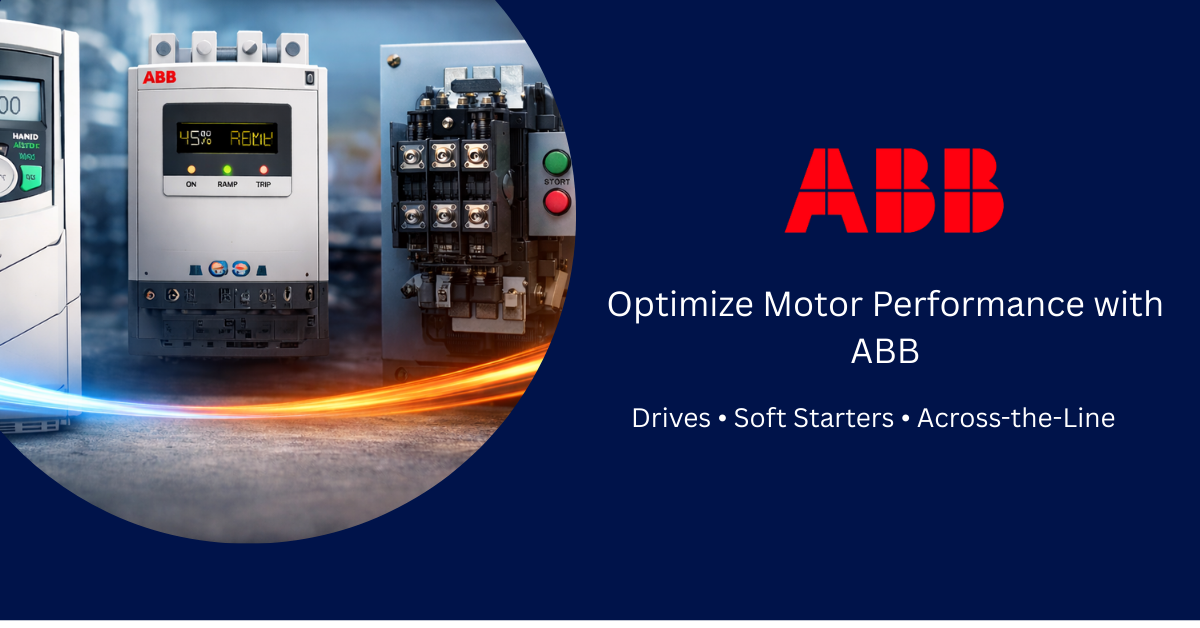
Motor control equipment plays a critical role in system performance, energy efficiency, and long-term reliability. ABB offers a full range of motor control solutions, including variable frequency drives (VFDs), soft starters, and across-the-line starters. Each technology serves a different purpose, and selecting the right one depends on application demands, operating conditions, and lifecycle cost considerations.
Understanding how these options differ helps facilities choose the most efficient, reliable, and cost-effective solution for their operation.
Across-the-Line Starters
Across-the-line starters, also known as direct-on-line (DOL) starters, apply full voltage to a motor immediately upon startup. This approach is straightforward, economical, and commonly used in industrial environments.
However, instant full-voltage starting produces high inrush current and mechanical shock. This can increase wear on belts, couplings, gearboxes, and bearings. Because there is no ramping or speed control, across-the-line starters are typically reserved for smaller or non-critical motors where system stress is less of a concern.
Benefits
- Low initial cost
- Simple installation and maintenance
- Minimal configuration required
- Ideal for small, fixed-speed applications
Considerations
- High inrush current
- Increased mechanical and electrical stress
- No control over starting torque or acceleration
- Potentially higher long-term maintenance
ABB Soft Starters
ABB soft starters provide controlled motor acceleration by gradually increasing voltage during startup. This reduces electrical stress and mechanical shock, extending equipment life and minimizing system disturbances.
Soft starters are commonly used in pump, fan, and conveyor applications where motors run at constant speed but require a smoother startup. They help prevent belt slippage, pressure surges, and nuisance trips. While soft starters improve startup conditions, they do not regulate speed during operation, limiting energy optimization compared to a drive.
Benefits
- Reduced inrush current
- Smooth acceleration and deceleration
- Lower mechanical wear
- Built-in motor protection features
Considerations
- Fixed-speed operation once running
- Limited energy savings during steady-state operation
- Less process control compared to a VFD
ABB Variable Frequency Drives
ABB variable frequency drives take motor control further by adjusting speed, torque, and power output throughout operation. Instead of only smoothing startup, a VFD continuously matches motor output to system demand.
ABB’s general-purpose and industrial drives — such as the ACS580 and ACS880 families — are widely used in material handling, HVAC, pumping systems, and manufacturing processes where variable speed or precision control is required.
By controlling motor speed, drives can significantly reduce energy consumption, especially in centrifugal loads like fans and pumps. They also reduce mechanical wear, improve process consistency, and provide diagnostic data for predictive maintenance.
Benefits
- Adjustable speed and torque control
Energy savings, especially in variable load applications - Reduced mechanical stress
- Advanced diagnostics and monitoring
- Improved process consistency and uptime
Consideration
- Higher upfront cost
- Requires configuration and commissioning
- May be unnecessary for simple fixed-speed systems
How to Select the Best Option
Choosing between an ABB drive, soft starter, or across-the-line starter depends on system requirements, performance goals, and budget.
When an Across-the-Line Starter Is Suitable
- Small motors with infrequent starts
- Simple fixed-speed applications
- Low sensitivity to mechanical stress
Budget-driven projects
When a Soft Starter Is the Best Fit
- Applications with high startup stress
- Constant-speed operation
- Electrical infrastructure limitations
- Moderate cost constraints
When an ABB Drive Is Preferred
- Variable load or speed requirements
- Energy efficiency initiatives
- Precise process control needs
- High reliability and uptime expectations
Cost and Lifecycle Considerations
- Across-the-line starters have the lowest upfront cost but may increase long-term maintenance.
- Soft starters offer moderate cost with improved reliability.
- VFDs have higher initial cost but can significantly reduce operating expenses and downtime.
Maintenance and Operational Reliability
Where to Find ABB Products Through Lakeland Engineering
ABB motor control products are stocked and supported at Lakeland Engineering’s Minneapolis, Kansas City, and Omaha branches. Our team can assist with product selection, system upgrades, and application support to help you implement the right solution for your facility.
Related Posts
Secure Remote Access for Industrial Machines with Ewon Cosy+