- Product Spotlight, Supplier Products
How Anybus Gateways Help Industrial Networks Communicate
- By Skylee Schwingler-lee
Factories are weird little civilizations. Machines speak different languages, often written decades apart by entirely different engineering tribes. One PLC speaks PROFINET, another device insists on EtherNet/IP, and some older piece of equipment is still muttering Modbus like it’s 1997. None of them naturally understands each other. Yet production lines still have to run like a synchronized orchestra. That’s where devices like Anybus gateways come in—they’re essentially translators for industrial automation.
Bridging Industrial Networks with Anybus Communication Gateways
In modern manufacturing environments, communication between machines, controllers, and monitoring systems is critical. Production equipment often comes from multiple manufacturers and may operate using completely different industrial protocols. Without a reliable way to bridge those communication gaps, data becomes isolated, systems become harder to integrate, and troubleshooting becomes significantly more difficult.
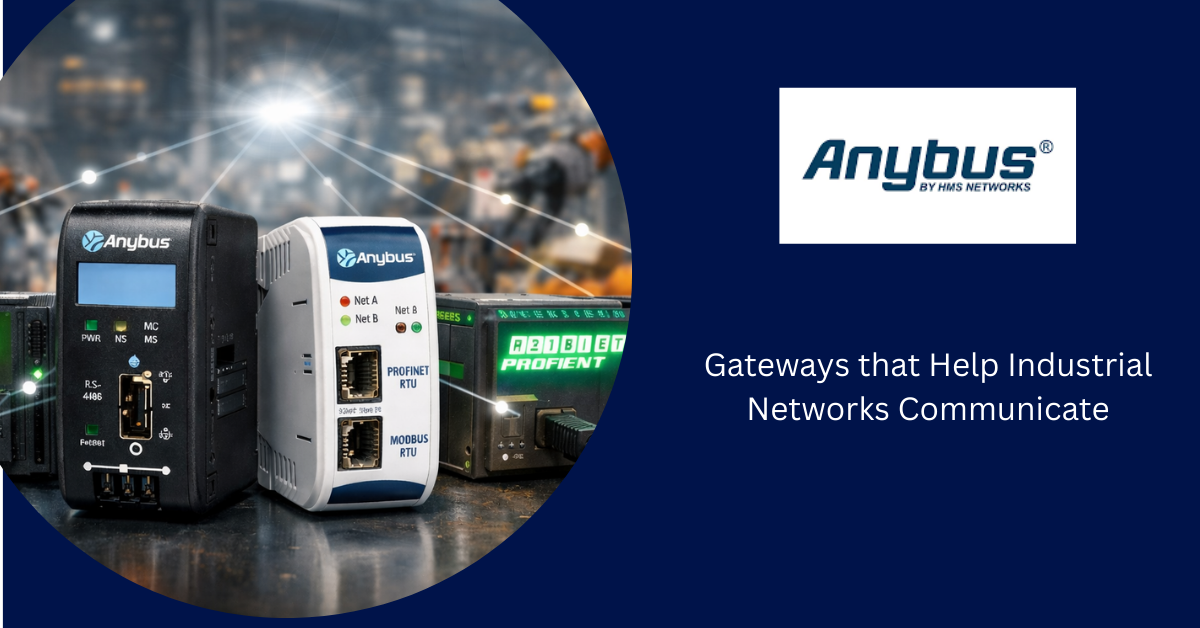
That’s where Anybus communication gateways from HMS Networks provide a practical solution. These devices are designed to translate data between different industrial networks, allowing equipment that speaks different protocols to communicate seamlessly.
At Lakeland Engineering Equipment Company, we help customers integrate and support industrial communication infrastructure, and Anybus solutions are a powerful tool for connecting otherwise incompatible systems.
The Challenge of Mixed Industrial Protocols
Industrial facilities rarely operate on a single network protocol. A plant may run Allen-Bradley PLCs using EtherNet/IP, Siemens equipment communicating over PROFINET, and legacy devices that rely on Modbus or CAN networks. Each of these protocols was designed for a specific ecosystem, and they don’t automatically talk to one another.
Replacing equipment just to match communication protocols is rarely practical. The cost of replacing drives, PLCs, or automation hardware can be enormous—not to mention the downtime involved.
Instead, many facilities rely on industrial communication gateways that translate data between networks in real time. This allows existing equipment to remain in place while still enabling system integration and data visibility.
How Anybus Gateways Solve the Problem
Anybus gateways act as protocol translators between industrial networks. The gateway sits between two different communication systems and converts data so both sides can understand it.
For example, an Anybus gateway can allow a PROFINET PLC to communicate with a Modbus device, or connect an EtherNet/IP system to a CAN-based network. Instead of redesigning the entire control architecture, the gateway simply bridges the two protocols.
This approach simplifies system integration and allows engineers to build flexible automation systems without being locked into a single network standard.
Because the gateway performs the protocol translation automatically, engineers can integrate machines, drives, sensors, and controllers from different manufacturers while maintaining reliable communication.
Common Applications for Anybus Technology
Anybus communication gateways are commonly used in a wide range of industrial environments where multiple networks must operate together.
Manufacturers often use them to integrate new automation equipment with legacy machinery, allowing older systems to remain productive while newer control platforms are introduced.
They are also frequently used in machine builder applications, where OEM equipment must connect to the customer’s preferred industrial network. Instead of redesigning the entire machine control system, a gateway allows the equipment to communicate with whatever network protocol the facility uses.
Another common use case involves data integration for monitoring and analytics systems. Gateways can help route production data from machines into SCADA systems, industrial PCs, or data collection platforms used for predictive maintenance and performance analysis.
Why Industrial Communication Matters
Reliable communication between machines isn’t just a convenience—it’s essential for modern manufacturing. As facilities adopt more automation, data collection, and remote monitoring, the ability for systems to exchange information becomes increasingly important.
Without proper communication infrastructure, production data becomes fragmented, troubleshooting becomes more difficult, and system upgrades become more complicated.
By enabling devices to communicate across different protocols, technologies like Anybus gateways help create more flexible and scalable automation systems.
Supporting Industrial Connectivity
At Lakeland Engineering Equipment Company, we work with customers to support automation, networking, and communication infrastructure across a wide range of industrial environments. Solutions like Anybus gateways help bridge communication gaps between equipment, enabling smoother integration and better visibility into production systems.
Our team supports customers across the Midwest and Mountain regions, with Anybus solutions available through our Minneapolis, Omaha, Kansas City, and Denver locations. Whether you’re integrating new automation equipment, connecting legacy machinery, or expanding industrial networking capabilities, communication gateways provide a practical way to keep systems connected without requiring a complete redesign of existing infrastructure.
If you’re evaluating industrial networking solutions or looking to integrate multiple communication protocols within your system, Lakeland’s team can help identify the right gateway for your application.
Related Posts

Meet Andrew Tuggle: Building Relationships in Kansas City