- Product Spotlight
Dynapar Encoders 101: Types, Specs, and How to Choose the Right One
- By Marketing
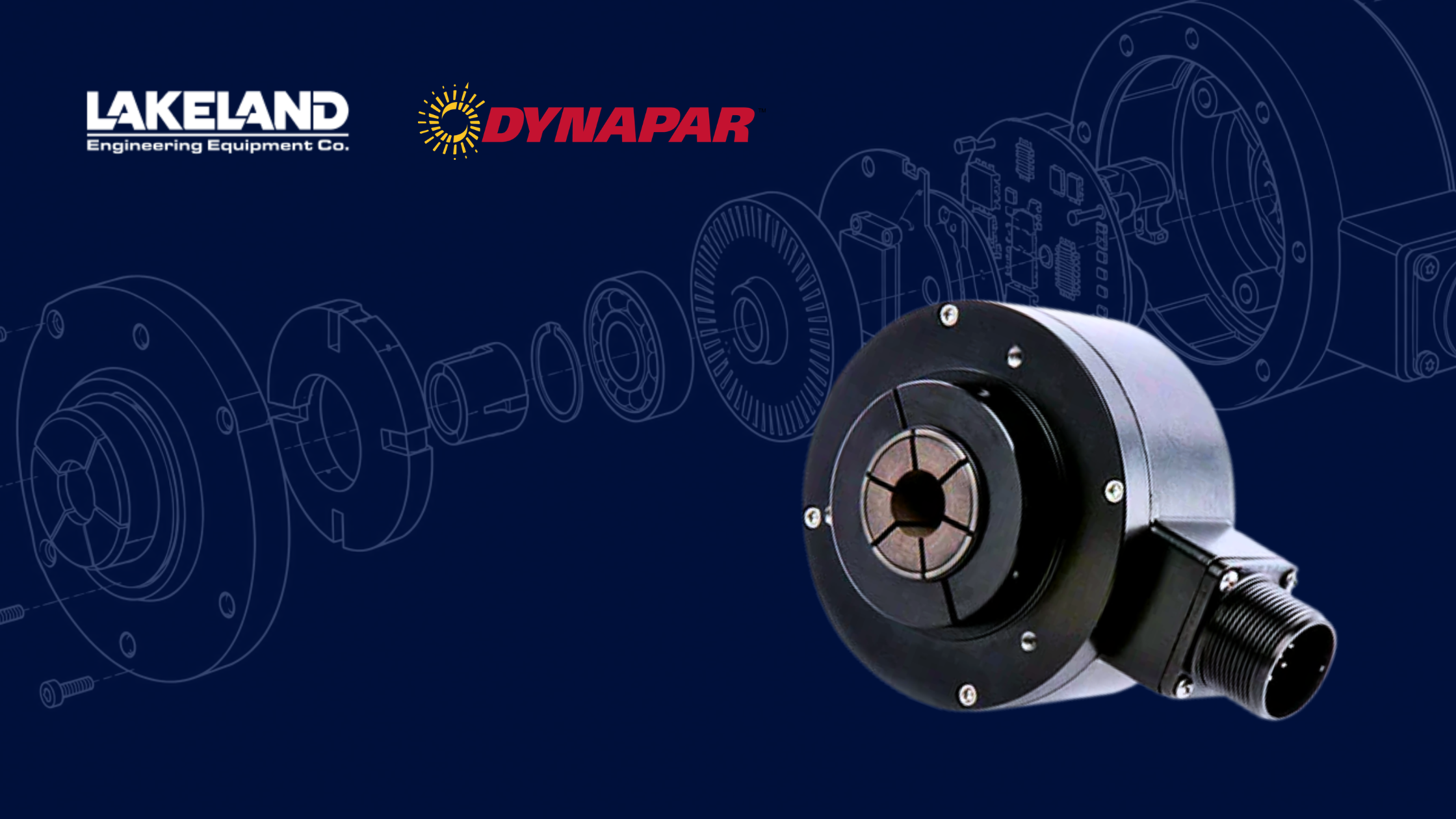
A Dynapar encoder provides the motion feedback industrial control systems need to monitor position, speed, direction, and movement. These encoders are used across manufacturing and automation equipment, including motors, conveyors, machine tools, packaging systems, and material handling equipment.
Dynapar offers multiple encoder types, sensing technologies, mounting configurations, and electrical outputs. Choosing the right Dynapar encoder requires matching these options to the mechanical, electrical, and environmental requirements of the application.
This guide covers the main types of Dynapar encoders, the specifications that matter during selection, and the questions to answer before choosing a model.
What Is a Dynapar Encoder?
A Dynapar encoder is an electromechanical feedback device that converts the rotation of a shaft into an electrical signal. A PLC, drive, counter, or controller interprets that signal to determine how equipment is moving.
Depending on the encoder and control system, this feedback can be used to measure:
- Position
- Rotational speed
- Direction
- Distance or displacement
Dynapar produces rotary encoders for a range of industrial motion applications. The two primary categories are incremental and absolute encoders.
Incremental vs. Absolute Dynapar Encoders
Choosing between incremental and absolute feedback is one of the first steps in selecting an encoder.
Dynapar Incremental Encoders
An incremental encoder generates pulses as its shaft rotates. The connected control system counts those pulses to measure movement or calculate speed.
Many incremental encoders use two output channels, commonly called A and B. The relationship between the two signals allows the controller to determine direction. Some models also provide an index or Z channel that generates a reference signal once per revolution.
Incremental Dynapar encoders are commonly used for:
- Motor speed feedback
- Conveyor monitoring
- Length measurement
- Machine positioning
- Process equipment
- Industrial automation
Because incremental encoders measure changes from a reference point, equipment may need to establish a home or reference position after startup or power loss.
Dynapar Absolute Encoders
An absolute encoder assigns a unique value to each shaft position. This allows the control system to determine the encoder’s position directly instead of calculating it from a starting reference.
Absolute feedback can be valuable when equipment needs to know its position immediately after startup or when returning to a home position would be difficult or inefficient.
Dynapar absolute encoders can be used in robotics, material handling systems, machine tools, automated positioning equipment, and other applications requiring position feedback.
Optical vs. Magnetic Dynapar Encoders
Dynapar encoders are also available with different sensing technologies.
Optical encoders use a light source and optical sensing components to detect movement. They are frequently used for applications requiring accurate, high-resolution motion feedback.
Magnetic encoders use changes in a magnetic field to detect rotation. They can be useful in demanding industrial environments where equipment may encounter dust, dirt, oil, vibration, or other contaminants.
The appropriate technology depends on the required precision and the conditions surrounding the encoder.
Key Dynapar Encoder Specifications
Once you know the basic encoder type, compare individual models based on the specifications that affect performance and compatibility.
Resolution
Resolution determines how finely an encoder can measure movement.
For incremental Dynapar encoders, resolution is commonly expressed in pulses per revolution, or PPR. Higher PPR values provide more feedback points during each shaft rotation.
Absolute encoder resolution is typically expressed in bits, which determines the number of unique positions available within a revolution.
Choose resolution based on the smallest movement the control system actually needs to detect. Higher resolution does not automatically produce better system performance.
Shaft and Mounting Configuration
The encoder needs to physically fit the motor or machine.
Dynapar encoder configurations include:
- Shafted encoders, which connect to the machine shaft through a coupling
- Hollow-shaft encoders, which mount directly over the machine or motor shaft
- Hub-shaft encoders, which provide another direct-mount option for compact installations
Check shaft or bore diameter, mounting dimensions, available clearance, and installation method before choosing a model.
Electrical Output and Interface
A Dynapar encoder must also communicate correctly with the receiving PLC, VFD, drive, counter, or controller.
Review specifications such as:
- Supply voltage
- Output type
- Output channels
- Maximum output frequency
- Communication protocol
- Cable or connector configuration
For absolute encoders, verify that the communication interface is supported by the existing control system.
For applications combining motor speed control with encoder feedback, understanding how variable frequency drives and encoders work together can help when evaluating the complete motion control system.
Operating Speed
The encoder’s rated operating speed must accommodate the maximum RPM of the shaft.
With incremental encoders, resolution and speed also determine how frequently pulses are generated. A high-PPR encoder operating at high RPM can produce a high output frequency, so both the encoder and receiving hardware must be capable of processing the signal.
Environmental Requirements
Industrial encoders may operate around dust, oil, moisture, vibration, shock, and changing temperatures.
Review specifications such as:
- IP rating
- Operating temperature
- Shock resistance
- Vibration resistance
- Bearing load
- Enclosure construction
Environmental requirements are particularly important when selecting an encoder for equipment operating continuously or in harsh manufacturing conditions.
How to Choose the Right Dynapar Encoder
Before comparing individual Dynapar models, define what the application actually requires.
Start by answering these questions:
- What needs to be measured? Determine whether you need speed, direction, relative position, absolute position, or multiple forms of feedback.
- Incremental or absolute? Decide whether the machine can establish a reference position after startup or needs immediate position information.
- What resolution is required? Identify the smallest movement the control system needs to detect.
- How will it mount? Confirm shaft size, bore diameter, mounting configuration, and available space.
- What electrical interface is required? Check compatibility with the PLC, drive, VFD, counter, or controller.
- What is the maximum operating speed? Match the encoder’s RPM and frequency capabilities to the equipment.
- What environmental conditions are present? Account for temperature, moisture, contaminants, shock, and vibration.
These requirements provide a practical starting point for narrowing the available Dynapar encoder options.
Find the Right Dynapar Encoder With Lakeland Engineering
Lakeland Engineering is an authorized Dynapar distributor supplying encoder solutions for industrial automation, motion control, motor feedback, and manufacturing applications.
Lakeland can help identify a suitable Dynapar encoder based on your required resolution, mounting configuration, electrical interface, operating speed, and environmental conditions. Lakeland also supplies complementary industrial automation products for building and maintaining motion control systems.
If you are replacing an existing encoder or selecting one for a new application, contact Lakeland Engineering to discuss your equipment and application requirements.
Related Posts